ATMA Scheme: Objectives, Structure, Activities, Funding Pattern & Farmer Benefits
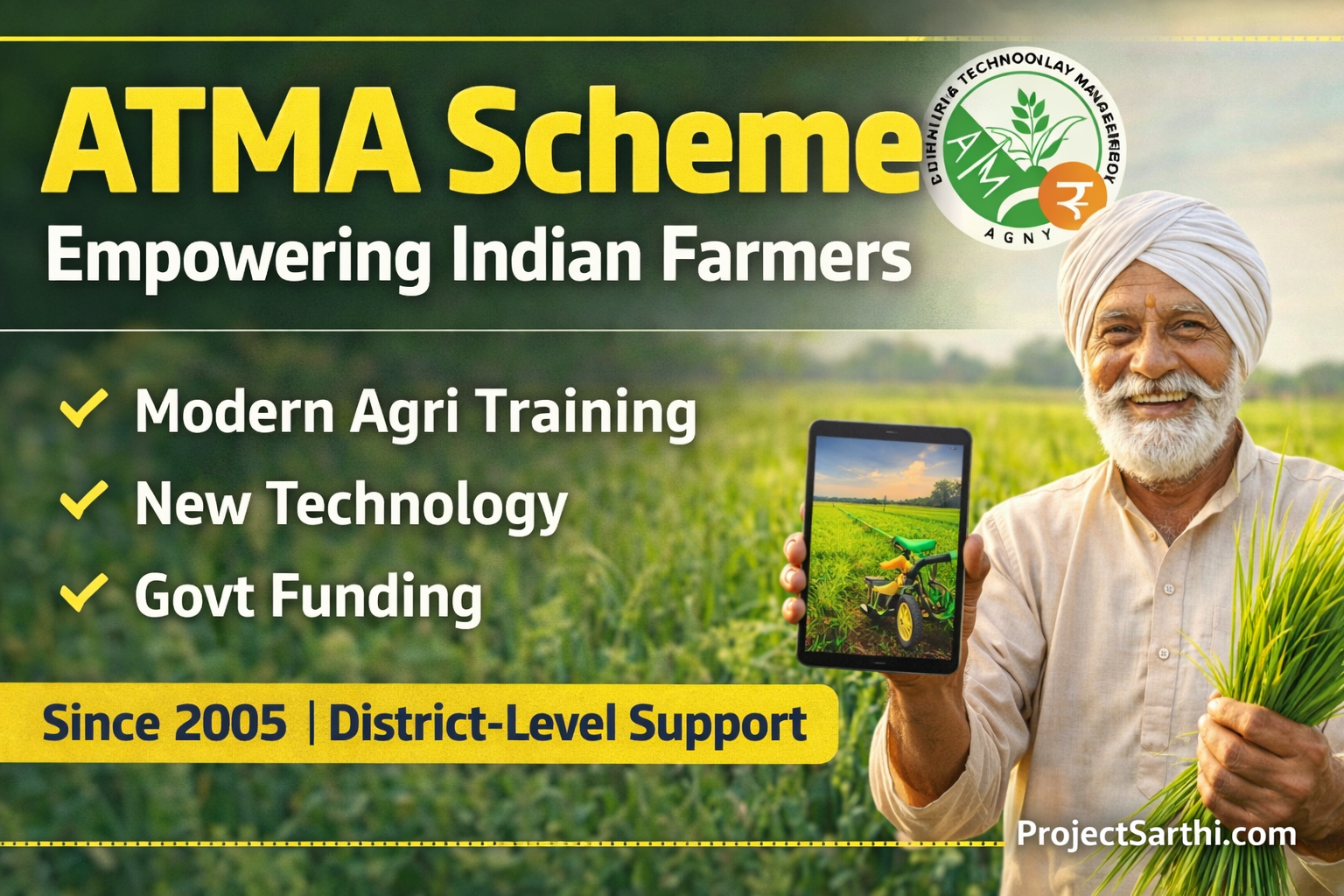
The Agriculture Technology Management Agency (ATMA) Scheme is one of the most important government initiatives for empowering Indian farmers with modern agricultural knowledge and technology. Launched in 2005 as a Centrally Sponsored Scheme, ATMA Scheme operates at the district level across India and plays a key role in bridging the gap between agricultural research institutions and farmers at the grassroots level.
In this comprehensive guide, we cover everything about the ATMA Scheme — its objectives, structure, activities, funding pattern, eligibility, benefits, key components, and how farmers can take advantage of this scheme. For more government scheme updates and agricultural news, visit ProjectSarthi.com.
What is the Agriculture Technology Management Agency (ATMA) Scheme?
The Agriculture Technology Management Agency, commonly known as ATMA, is a district-level autonomous institution set up under the Centrally Sponsored Scheme called "Support to State Extension Programmes for Extension Reforms". It was first pilot-tested under the World Bank-funded National Agricultural Technology Project (NATP) from 1998 to 2005 in seven states — Andhra Pradesh, Bihar, Himachal Pradesh, Jharkhand, Odisha, Maharashtra, and Punjab.
After the success of the pilot project, the Government of India formally launched the ATMA Scheme in 2005-06 across the country. Currently, the scheme is being implemented as a component of the Sub-Mission on Agricultural Extension (SMAE) under the umbrella scheme Green Revolution – Krishonnati Yojana.
ATMA is a registered society of key stakeholders — including farmers, government departments, research institutions, NGOs, and the private sector — working together for sustainable agricultural development at the district level. It acts as a focal point for integrating research and extension activities and decentralizing the management of the public agricultural technology system.
ATMA Scheme – Overview
| Scheme Name | Support to State Extension Programmes for Extension Reforms (ATMA Scheme) |
| Full Form | Agriculture Technology Management Agency |
| Launched In | 2005-06 (Pilot tested from 1998–2005) |
| Launched By | Ministry of Agriculture and Farmers Welfare, Government of India |
| Scheme Type | Centrally Sponsored Scheme |
| Umbrella Scheme | Sub-Mission on Agricultural Extension (SMAE) under Krishonnati Yojana |
| Implementation Level | District Level (through ATMA societies) |
| Coverage | 691 districts across 28 States and 5 UTs |
| Funding Pattern | 90:10 (Centre:State) — 90% Central, 10% State |
| Nodal Agency | Department of Agriculture and Farmers Welfare (DACFW) |
| Official Website | krishivistar.gov.in / extensionreforms.dacnet.nic.in |
Objectives of the ATMA Scheme
The primary goal of the ATMA Scheme is to revitalize and reform the agricultural extension system in India by making it farmer-driven, demand-based, and accountable. The key objectives include:
1. Decentralized Extension Delivery: Making agricultural extension services decentralized at the district level so that local needs and conditions are addressed effectively.
2. Technology Dissemination: Ensuring that the latest agricultural technologies, good agricultural practices, and innovations developed by research institutions reach farmers at the grassroots level.
3. Farmer Participation: Increasing farmer input in program planning, resource allocation, and decision-making, especially at the block and village levels.
4. Integration of Research and Extension: Creating strong linkages between State Agricultural Universities (SAUs), Krishi Vigyan Kendras (KVKs), research stations, and the extension system.
5. Multi-Agency Approach: Encouraging partnerships between public agencies, private sector, NGOs, and farmer organizations for more effective extension delivery.
6. Farmer Empowerment: Supporting the formation of Farmer Interest Groups (FIGs), Commodity Interest Groups (CIGs), and Farmer Producer Organizations (FPOs) to strengthen farmers' collective bargaining power.
7. Sustainable Agriculture: Promoting environmentally friendly farming practices, soil health management, integrated pest management, and natural resource conservation.
For detailed information on more government agriculture schemes, visit ProjectSarthi.com.
Organizational Structure of ATMA
ATMA operates through a well-defined multi-level institutional framework — from the state level down to the village level. This bottom-up approach ensures that farmers' needs drive the planning and implementation of extension activities.
State Level
| Body | Role |
|---|---|
| State Level Sanctioning Committee (SLSC) | Apex body that approves the State Extension Work Plan (SEWP) |
| Inter Departmental Working Group (IDWG) | Day-to-day coordination and management of scheme activities |
| State Nodal Cell (SNC) | Ensures timely receipt of DAAPs and formulation of SEWP |
| SAMETI (State Agricultural Management & Extension Training Institute) | Training and capacity building of extension functionaries |
District Level
| Body | Role |
|---|---|
| ATMA Governing Board (GB) | Apex body at district level; chaired by District Collector; provides policy direction |
| ATMA Management Committee (AMC) | Executive body led by Project Director (PD-ATMA); handles day-to-day implementation |
| District Farmers Advisory Committee (DFAC) | Provides farmer feedback for district-level planning |
| Project Director (PD-ATMA) | Overall leadership for agricultural extension activities in the district |
Block Level
| Body | Role |
|---|---|
| Block Technology Team (BTT) | Team of agriculture and allied department officers; implements extension programs at block level |
| Block Farmers Advisory Committee (BFAC) | Group of selected farmers; advises BTT on local needs and priorities |
Village Level
| Body | Role |
|---|---|
| Farmer Friend (FF) | One Farmer Friend per two villages; serves as a link between farmers and the extension system; paid ₹6,000 per year |
| Farmer Interest Groups (FIGs) | Groups of 11–25 farmers formed around common interests |
| Commodity Interest Groups (CIGs) | Groups focused on specific commodities for collective action |
| Food Security Groups (FSGs) | Groups formed for food security and nutrition-related activities |
Key Activities Under the ATMA Scheme
The ATMA Scheme conducts a wide range of extension activities to transfer agricultural knowledge and technology to farmers. These activities are selected from an "ATMA Cafeteria" — a list of approved extension activities that districts can choose from based on local needs.
| Activity | Description |
|---|---|
| Farmer Training | Training programs on modern farming techniques, organic farming, IPM, precision agriculture, etc. conducted at block and district level |
| Farm Demonstrations | On-farm demonstrations showcasing benefits of new technologies, high-yield varieties, and improved practices |
| Exposure Visits | Visits to successful farms, research institutions, KVKs, and progressive agricultural models |
| Farm Schools | Season-long farmer-to-farmer learning programs conducted on progressive farmers' fields |
| Kisan Melas / Exhibitions | Large gatherings where farmers interact with scientists, access new technologies, and explore market linkages |
| Farmer-Scientist Interactions | Platforms for direct knowledge exchange between farmers and agricultural researchers |
| Mobilization of Farmer Groups | Formation and strengthening of FIGs, CIGs, and FPOs for collective bargaining and marketing |
| DAESI Program | Diploma in Agricultural Extension Services for Input Dealers — training input dealers to provide quality advisory |
| Skill Training for Rural Youth (STRY) | Skill development programs for rural youth in agriculture and allied sectors |
| ICT-Based Extension | Use of mobile apps, SMS alerts, WhatsApp groups, pico projectors, and digital tools for information dissemination |
For updates on agricultural training programs and farmer benefits, check ProjectSarthi.com.
Funding Pattern of the ATMA Scheme
The ATMA Scheme is funded as a Centrally Sponsored Scheme. The funding is shared between the Central Government and State Governments as follows:
| Category | Central Share | State Share |
|---|---|---|
| General States | 90% | 10% |
| North Eastern & Hilly States | 90% | 10% |
The 10% state share can come from cash contributions of the state or from contributions by beneficiaries and NGOs. The total funds are distributed across three levels:
District Level Programs: Approximately 77.5% of the total allocation goes to conduct district-level extension activities through ATMAs.
State Level Programs: Around 10.25% is distributed for state-level activities including SAMETI operations and state coordination.
Central Level Activities: About 12.25% is retained by the Central Government for monitoring, evaluation, and other operational activities.
ATMA Scheme – Key Planning Documents
ATMA follows a structured, bottom-up planning approach. The key planning documents prepared under the scheme are:
| Document | Description |
|---|---|
| Strategic Research and Extension Plan (SREP) | A comprehensive document identifying research and extension priorities for the district based on agro-ecological conditions and technology gaps |
| District Agriculture Action Plan (DAAP) | Annual action plan prepared at the district level based on SREP and farmer feedback through DFAC |
| Block Action Plan (BAP) | Extension action plan prepared at the block level by BTT in consultation with BFAC |
| State Extension Work Plan (SEWP) | State-level plan that consolidates all DAAPs and is approved by SLSC |
Role of SAMETI in the ATMA Scheme
The State Agricultural Management and Extension Training Institute (SAMETI) is the state-level training institute set up under the ATMA framework. Its key functions include:
SAMETI prepares an Annual Training Calendar for capacity building of extension functionaries across the state. It conducts Training Need Assessments (TNA) for various cadres of agricultural and allied department officers. It provides consultancy services to ATMA in areas such as planning, implementation, monitoring, and evaluation. SAMETI also develops linkages with KVKs, State Agricultural Universities, EEIs (Extension Education Institutes), and MANAGE (National Institute of Agricultural Extension Management, Hyderabad).
How Farmers Can Benefit from the ATMA Scheme
The ATMA Scheme offers multiple benefits to farmers across India. Here is how farmers can take advantage of this scheme:
Free Training Programs: Farmers can attend training programs on modern farming techniques, organic farming, integrated pest management, post-harvest technology, and more — all conducted free of cost at the block and district level.
Exposure Visits: Selected farmers get opportunities to visit progressive farms, research stations, and KVKs in other districts or states to learn about best practices and successful farming models.
Farm Schools: Farmers can learn directly from progressive farmers in their area through season-long farm school programs that demonstrate new crop varieties and improved practices.
Farmer Group Formation: Farmers can join or form FIGs and CIGs through ATMA, which helps them access better markets, negotiate prices collectively, and avail government scheme benefits as a group.
Access to Technology: Through ATMA demonstrations and Kisan Melas, farmers get direct access to new seed varieties, farm machinery, fertilizer technologies, and other agricultural innovations.
Farmer Friend Support: At the village level, the designated Farmer Friend serves as a direct contact point for farmers to receive advisory services and connect with the extension system.
Farmer Awards: Outstanding and progressive farmers at various levels are recognized with awards to encourage competition and adoption of modern practices.
State/UT-wise Number of Farmers Trained Under ATMA Scheme (2021-22 to 2024-25)
| Sl No | State/UT | 2021-22 | 2022-23 | 2023-24 | 2024-25 | Total |
|---|---|---|---|---|---|---|
| 1 | Andhra Pradesh | 1,08,684 | 28,103 | 37,553 | 0 | 5,26,384 |
| 2 | Bihar | 3,46,308 | 3,95,982 | 5,74,595 | 1,55,888 | 17,93,740 |
| 3 | Chhattisgarh | 1,04,945 | 1,14,488 | 19,623 | 18,641 | 3,54,322 |
| 4 | Goa | 10,423 | 6,271 | 14,449 | 8,614 | 45,774 |
| 5 | Gujarat | 3,00,183 | 3,84,771 | 1,40,042 | 90,520 | 12,19,713 |
| 6 | Haryana | 47,504 | 50,606 | 25,320 | 5,674 | 1,71,522 |
| 7 | Himachal Pradesh | 31,860 | 15,784 | 42,925 | 8,399 | 1,22,539 |
| 8 | Jammu & Kashmir | 21,367 | 24,215 | 24,162 | 40,840 | 1,16,106 |
| 9 | Jharkhand | 40,373 | 44,912 | 40,447 | 23,133 | 2,17,636 |
| 10 | Karnataka | 1,20,270 | 2,60,928 | 1,40,256 | 14,372 | 7,07,043 |
| 11 | Kerala | 25,112 | 1,07,649 | 1,07,174 | 24,306 | 2,91,401 |
| 12 | Maharashtra | 3,00,551 | 4,36,346 | 4,56,013 | 1,14,446 | 15,27,101 |
| 13 | Madhya Pradesh | 51,269 | 1,86,507 | 3,75,572 | 49,490 | 7,39,903 |
| 14 | Odisha | 52,300 | 84,526 | 40,607 | 20,000 | 2,57,751 |
| 15 | Punjab | 74,724 | 73,614 | 64,048 | 58,218 | 3,13,483 |
| 16 | Rajasthan | 2,08,536 | 2,46,830 | 20,403 | 40,144 | 6,24,220 |
| 17 | Telangana | 13,843 | 4,260 | 311 | 0 | 46,149 |
| 18 | Tamil Nadu | 4,58,674 | 4,88,331 | 5,20,316 | 4,53,661 | 24,24,064 |
| 19 | Uttar Pradesh | 5,09,728 | 4,70,492 | 6,02,577 | 4,97,758 | 27,38,834 |
| 20 | Uttarakhand | 40,309 | 53,890 | 46,775 | 35,391 | 2,39,497 |
| 21 | West Bengal | 1,81,816 | 2,98,899 | 1,77,855 | 67,025 | 8,74,415 |
| 22 | Assam | 18,347 | 40,025 | 40,845 | 25,730 | 1,30,214 |
| 23 | Arunachal Pradesh | 1,18,463 | 56,682 | 23,000 | 0 | 2,52,120 |
| 24 | Manipur | 12,570 | 22,776 | 5,400 | 19,331 | 78,606 |
| 25 | Meghalaya | 15,406 | 16,265 | 30,585 | 21,903 | 97,037 |
| 26 | Mizoram | 3,460 | 7,440 | 3,558 | 1,600 | 20,838 |
| 27 | Nagaland | 1,800 | 58,588 | 41,571 | 7,780 | 1,74,633 |
| 28 | Tripura | 3,348 | 5,592 | 14,611 | 16,914 | 50,497 |
| 29 | Sikkim | 5,658 | 6,576 | 7,791 | 0 | 28,353 |
| 30 | Delhi | 200 | 5,500 | 0 | 0 | 5,900 |
| 31 | Puducherry | 1,792 | 7,146 | 10,837 | 2,663 | 26,572 |
| 32 | Andaman & Nicobar | 7,967 | 7,641 | 9,833 | 7,332 | 38,146 |
| 33 | Ladakh | 1,014 | 244 | 1,535 | 0 | 13,401 |
| Total | 32,38,804 | 40,11,879 | 36,60,589 | 18,29,773 | 1,62,67,914 |
📊 Data Source: data.gov.in
To stay updated on agriculture schemes and farmer benefits, bookmark ProjectSarthi.com.
ATMA Scheme – Achievements and Impact
Since its nationwide implementation, the ATMA Scheme has made a significant impact on Indian agriculture. Here are some key achievements:
The scheme is currently operational in 691 districts across 28 states and 5 Union Territories, making it one of the largest agricultural extension programs in the world.
During 2018-19 alone, approximately 19.18 lakh farmers received training benefits under the ATMA Scheme. In the following year (2019-20), another 7.73 lakh farmers were trained.
ATMA has trained over 3 lakh women farmers in areas including organic farming, food processing, and value addition, contributing significantly to women's empowerment in rural areas.
Over 50% of farmers trained under ATMA have adopted improved agricultural techniques, leading to higher yields in crops such as paddy, wheat, and horticultural produce.
The scheme has successfully helped thousands of farmers connect with Farmer Producer Organizations (FPOs) and market platforms like e-NAM (National Agriculture Market).
ATMA Scheme – Timeline and Evolution
| Year | Milestone |
|---|---|
| 1998–2005 | Pilot tested under NATP (World Bank funded) in 28 districts across 7 states |
| 2005-06 | Officially launched as Centrally Sponsored Scheme across India |
| 2007 | National Development Council highlighted need for revamping extension system |
| 2010 | Revised ATMA Scheme launched with strengthened manpower and infrastructure |
| 2014 | Included under Sub-Mission on Agricultural Extension (SMAE) and NMAET |
| 2017 | Brought under Green Revolution – Krishonnati Yojana umbrella |
| 2025 | Revised operational guidelines released; focus on digital extension and climate resilience |
Challenges Faced by the ATMA Scheme
Despite its success, the ATMA Scheme faces several challenges that need to be addressed for greater impact:
Inadequate Budget: Many states face insufficient budget allocation, which limits the scale and quality of extension activities that can be conducted at the district and block level.
Manpower Shortage: There is a shortage of trained extension functionaries at the block and village levels, making it difficult to reach all farmers, especially in remote areas.
Farmer Resistance: Some farmers are reluctant to adopt new technologies and shift away from traditional farming methods, which slows down the adoption of improved practices.
Limited Digital Infrastructure: While ICT-based extension is a focus area, inadequate internet connectivity and digital literacy in rural areas remain significant barriers.
Coordination Issues: Effective convergence between multiple departments (agriculture, horticulture, animal husbandry, fisheries) at the district level sometimes remains a challenge.
Allied Departments Covered Under ATMA
ATMA does not focus only on crop agriculture. It integrates extension activities across multiple allied departments, including Agriculture, Horticulture, Animal Husbandry, Fisheries, Sericulture, Forestry, and Soil Conservation. This farming systems approach ensures that farmers receive holistic support covering all aspects of their livelihood.
How to Contact ATMA in Your District
Farmers who want to benefit from ATMA activities can connect through the following channels:
Block Level: Contact the Block Technology Manager (BTM) or Assistant Technology Manager (ATM) at your nearest block agriculture office.
Village Level: Reach out to the designated Farmer Friend in your village who serves as a link between you and the extension system.
District Level: Contact the Project Director, ATMA at the District Agriculture Office.
Online: Visit the official portal at krishivistar.gov.in or extensionreforms.dacnet.nic.in for information and updates.
For more help finding the right government scheme for your needs, visit ProjectSarthi.com.
Frequently Asked Questions (FAQs)
Q1. What is the full form of ATMA in agriculture?
ATMA stands for Agriculture Technology Management Agency. It is a district-level autonomous institution set up to coordinate and manage agricultural extension services for farmers.
Q2. When was the ATMA Scheme launched?
The ATMA Scheme was officially launched in 2005-06 as a Centrally Sponsored Scheme. It was pilot tested from 1998 to 2005 under the National Agricultural Technology Project (NATP) funded by the World Bank.
Q3. What is the main objective of the ATMA Scheme?
The main objective is to make agricultural extension services decentralized, farmer-driven, and demand-based. It aims to transfer the latest agricultural technologies and best practices to farmers through training, demonstrations, exposure visits, Kisan Melas, and other extension activities.
Q4. How many districts is ATMA implemented in?
As per the latest data, ATMA is being implemented in 691 districts across 28 states and 5 Union Territories in India.
Q5. What is the funding pattern of the ATMA Scheme?
The funding pattern is 90:10 — the Central Government provides 90% of the funds and the remaining 10% is borne by the State Government.
Q6. Who heads the ATMA at the district level?
The ATMA Governing Board is chaired by the District Collector, while the day-to-day implementation is managed by the Project Director (PD-ATMA) through the ATMA Management Committee.
Q7. What is the role of a Farmer Friend under ATMA?
A Farmer Friend is appointed at the village level — one per two villages. The Farmer Friend serves as a link between farmers and the extension system, helping disseminate information and facilitate access to government schemes. The Farmer Friend is paid ₹6,000 per year.
Q8. What activities are conducted under the ATMA Scheme?
Key activities include farmer training programs, on-farm demonstrations, exposure visits to progressive farms and research stations, farm schools, Kisan Melas, farmer-scientist interactions, formation of FIGs and CIGs, DAESI training for input dealers, and ICT-based extension services.
Q9. Under which umbrella scheme does ATMA currently operate?
ATMA currently operates under the Sub-Mission on Agricultural Extension (SMAE), which is a component of the Green Revolution – Krishonnati Yojana.
Q10. What is SAMETI under the ATMA framework?
SAMETI stands for State Agricultural Management and Extension Training Institute. It is the state-level training institute responsible for capacity building of extension functionaries and providing consultancy support to ATMAs in the state.
Q11. How can a farmer benefit from the ATMA Scheme?
Farmers can attend free training programs, participate in exposure visits, join farm schools, form or join Farmer Interest Groups, access new technologies through demonstrations and Kisan Melas, and receive advisory support through the Farmer Friend at the village level.
Q12. What is SREP in the ATMA Scheme?
SREP stands for Strategic Research and Extension Plan. It is a comprehensive planning document that identifies research and extension priorities for a district based on its agro-ecological conditions, existing technology gaps, and farmer needs.
Q13. Is the ATMA Scheme only for crop farming?
No. ATMA follows a farming systems approach and covers allied sectors including horticulture, animal husbandry, fisheries, sericulture, forestry, and soil conservation — providing holistic support to farmers.
Q14. How can I contact ATMA in my district?
You can contact the Block Technology Manager or Assistant Technology Manager at your block agriculture office, the Farmer Friend in your village, or the Project Director ATMA at the District Agriculture Office. Online information is available at krishivistar.gov.in.
Disclaimer: The information in this article is based on official government sources including PIB, Ministry of Agriculture, and state ATMA portals. Farmers and readers are advised to verify details from official websites. For the latest government scheme updates, visit ProjectSarthi.com.
Eligibility Criteria
All farmers including small, marginal, women farmers and farmer groups. No direct application required; participation through district ATMA units.
Benefits
Free farmer training programs
Exposure visits
Farm demonstrations
Formation of FIGs/CIGs/FPOs
Skill training for rural youth
ICT-based advisory services
Documents Required
No direct individual application. Participation through local agriculture office / ATMA unit.
Scheme Details
| Full Name | ATMA Scheme: Objectives, Structure, Activities, Funding Pattern & Farmer Benefits |
| Short Title | ATMA Scheme |
| Level | Central |
| Scheme For | Farmers across India |
| Ministry | Ministry Of Agriculture and Farmers Welfare |
| Categories | Agriculture,Rural & Environment, Skills & Employment |
| States | All India |
| Gender | All |
| Age Range | 18 — Any years |
| Area | Rural |
| Source | krishivistar.gov.in ↗ |
📌 Related Government Schemes
Financial Assistance to Mussel Culture and Oyster Farming in Goa
Mukhya Mantri Mahila Kisan Sashaktikaran Yojana
 Central