India Science and Research Fellowship (ISRF) 2026: Deadlines, Eligibility
India Science and Research Fellowship (ISRF) 2025-26: Complete Guide for Researchers from Neighbouring Countries
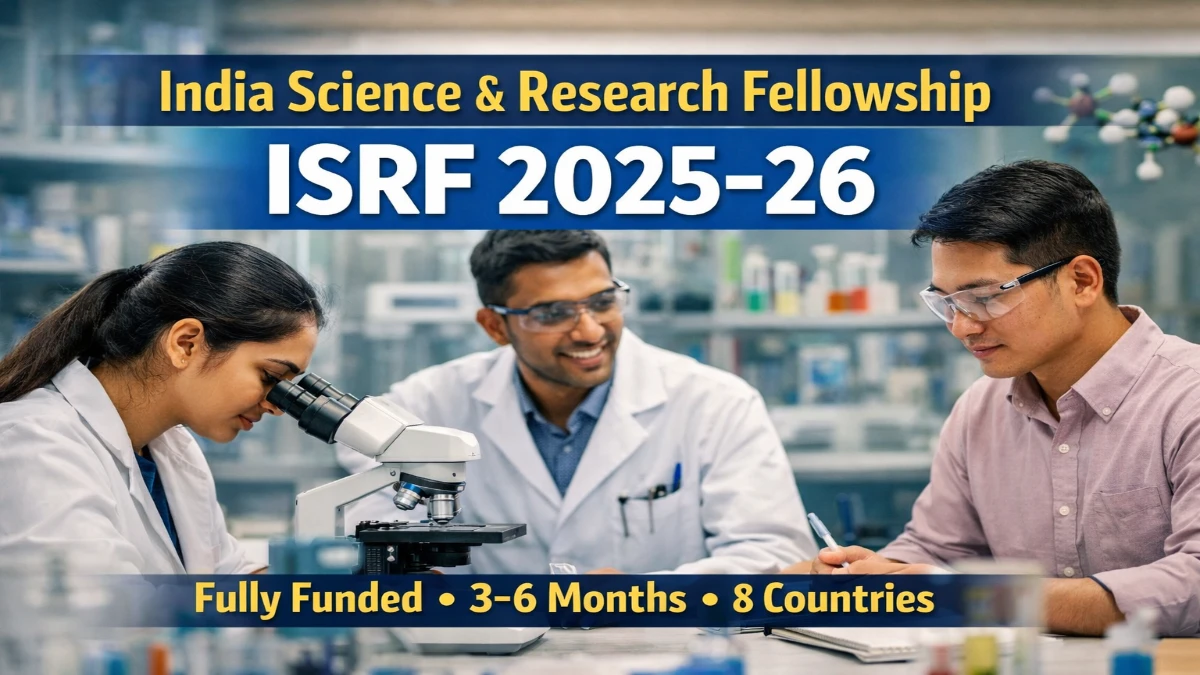
The India Science and Research Fellowship (ISRF) is a fully funded visiting research fellowship offered by the Department of Science and Technology (DST), Government of India, and implemented by the Indian National Science Academy (INSA), New Delhi. It enables researchers and scientists from eight neighbouring countries to conduct advanced research at premier Indian institutions for 3 to 6 months.
The 2025-26 call opened on 31 December 2025, and the last date for proposal submission is 31 March 2026. If you are a researcher from Afghanistan, Bangladesh, Bhutan, Maldives, Myanmar, Nepal, Sri Lanka, or Thailand, this is one of the few government-funded programmes that gives you direct access to India’s top research laboratories and academic institutions with full financial support.
This is not a degree programme. It is not a permanent position. It is a short-term visiting fellowship designed specifically for international scientific collaboration, where you work alongside an Indian host scientist on a research project in your area of expertise. The fellowship covers your monthly living expenses, round-trip airfare, visa fees, and provides research grants to both you and your Indian host scientist.
Since the programme began in 2015, approximately 168 fellows from all eight eligible countries have been awarded this fellowship. In the most recent completed round, 48 researchers were selected, working across areas such as Life Sciences, Veterinary Science, Fisheries, Medicine, Agriculture, Geology, Chemistry, Mathematics, Computer Science, and Engineering. Up to 80 fellowships (10 per country) can be awarded annually, though actual numbers depend on the quality of applications received in each round.
Why ISRF Matters: What You Actually Get
Many fellowship listings reduce ISRF to a bullet-point summary of stipend and deadline. But the real value of this programme goes well beyond the monthly allowance.
First, the access. ISRF places you at premier Indian research laboratories and academic institutions. India has a vast network of apex R&D institutions, from the IITs and IISc to CSIR labs, ICAR institutes, and AIIMS-affiliated medical research centres. For researchers from smaller neighbouring countries who may not have access to advanced equipment or large-scale facilities at home, this can be transformative. You get hands-on access to state-of-the-art instrumentation and infrastructure that might not exist in your home institution.
Second, the collaboration. The fellowship requires you to work with a specific Indian host scientist on a defined research project. This is not a general visit or a conference trip. It is sustained, focused research collaboration over 3 to 6 months, long enough to produce meaningful results. A number of quality research papers have been published by ISRF awardees from previous calls (2015 to 2019 and beyond), and fellows have also participated in conferences and symposiums during their stay.
Third, the network effect. The host scientist relationship often extends well beyond the fellowship period. Researchers who complete ISRF successfully leave with an established collaborator in India, access to a research group, and often co-authored publications. For early and mid-career researchers, this kind of international linkage can shape the trajectory of their entire research career.
Fourth, ISRF is one of the very few structured programmes that specifically targets South Asian scientific collaboration at the researcher level. Unlike larger multilateral schemes, ISRF is designed with the specific needs and contexts of India’s immediate neighbours in mind.
Financial Support: Complete Breakdown
The ISRF financial package is fully funded. Here is exactly what is covered.
Monthly Fellowship Allowance
Rs. 50,000 per month is provided to the fellow. This amount is intended to cover accommodation and living expenses, along with access to medical facilities as available at the host institution. Note that this is a composite amount. There is no separate accommodation allowance. You are expected to arrange your own accommodation using this fellowship amount, unless the host institution offers guest house or hostel facilities.
At current exchange rates, this translates to roughly USD 590 per month, or approximately BDT 67,000 for Bangladeshi researchers, NPR 94,000 for Nepali researchers, or LKR 180,000 for Sri Lankan researchers. The purchasing power in Indian cities varies significantly. In smaller cities and towns where many research institutions are located, Rs. 50,000 goes considerably further than in metros like Delhi, Mumbai, or Bangalore.
Contingency Grant to the Fellow
Rs. 10,000 is provided as a one-time contingency grant to the fellow for research-related miscellaneous expenses. This is a modest amount, but it can cover basic costs like photocopying, printing, consumables, or small purchases needed for your research work.
Research Grant for the Indian Host Scientist
Rs. 20,000 is provided as a one-time grant to the Indian host scientist through the host institution. This is meant to cover laboratory expenses related to the fellow’s research activities. This is an important detail because it means your presence does not come at a financial cost to the host lab. The host scientist has a small dedicated budget to support your work, which makes it easier for them to agree to host you.
Travel Support
Round-trip economy class airfare is provided from your place of employment in your home country to the Indian host institution, through the shortest route. Local transport by road or rail between the nearest airport and the host institution in India is also covered.
Visa Fee
The cost of your Indian visa will be reimbursed.
What Is Not Covered
The fellowship does not explicitly cover medical insurance. The brochure states that fellows should have their own medical insurance for the period of stay in India. This is an important requirement that applicants sometimes overlook. Make sure you arrange adequate medical insurance coverage before travelling to India.
Eligibility Criteria: Who Can Apply
The eligibility requirements are straightforward but strict. Every condition must be met. There are no exceptions or relaxation categories mentioned in the guidelines.
Nationality
You must be a citizen or permanent resident of one of the following eight countries: Afghanistan, Bangladesh, Bhutan, Maldives, Myanmar, Nepal, Sri Lanka, or Thailand. No other nationalities are eligible, regardless of the applicant’s research credentials.
Current Position
You must be actively engaged in research at a university or research institution in your home country. The official announcement specifically mentions researchers “holding permanent positions” in their home countries. This means the fellowship primarily targets faculty members and research scientists who are currently employed in academic or research roles, not independent or unemployed researchers.
Minimum Qualification
You must hold a Ph.D., or hold an M.Tech, M.Sc, or MBBS with 3 to 5 years of research or teaching experience. Applicants who are currently registered for a Ph.D. degree in their home country are also eligible to apply, even if the degree is not yet completed.
This means there are effectively three pathways to eligibility. The first is holding a completed Ph.D. in any relevant field. The second is holding a Master’s or medical degree with a demonstrated track record of 3 to 5 years of research or teaching. The third is being a currently registered Ph.D. student in your home country, which provides an important opportunity for doctoral scholars to gain international research exposure during their candidature.
Age Limit
You must be below 45 years of age as on 31 March 2026. This is calculated from the date of birth to 31 March of the fellowship year. There is no mention of any age relaxation for any category.
Residency Restriction
You must not hold any visa for temporary or permanent residency in India. This ensures the fellowship goes to researchers who are genuinely based in their home countries and who will use the fellowship for a defined research visit rather than as a pathway to extended stay.
Passport Requirement
You must possess a valid passport. Your passport details are required in the application form, and a copy of relevant passport pages (showing photograph, date of birth, date of issue, date of expiry, and residential address) must be submitted with the application.
Repeat Application Rule
An applicant is permitted to avail the fellowship only once during a period of 5 years. If you have received ISRF in the past 5 years, you cannot apply for the current cycle.
Research Areas Covered
ISRF covers research in frontier and advanced areas of science, including Medicine and Agriculture. The scope is intentionally broad. The programme accepts applications across all major disciplines of science and technology, including engineering and medical sciences. Based on past selection data, awarded fellows have worked in areas spanning Life Sciences, Veterinary Science, Fisheries, Medicine, Agriculture, Geology, Chemistry, Mathematics, Computer Science, and Engineering.
The key requirement is that your proposed research must be in an advanced or frontier area. Routine or purely descriptive work is less likely to be competitive. The selection committee evaluates proposals based on scientific merit and the proposed contribution to advanced research in the subject field.
How to Apply: Step-by-Step Process
The application process is paper-based or scan-based (not through an online portal). Applications must be submitted in the prescribed format available on the official websites.
Step 1: Identify and Secure an Indian Host Scientist
This is the most critical step, and it should be done well before the deadline. You need to identify an Indian scientist whose research aligns with your own area of expertise and who is willing to host you at their institution for 3 to 6 months. You must obtain a Letter of Acceptance from this host scientist on the host institution’s letterhead, confirming that they will support your research work in India.
The application form allows you to list up to three choices of Indian institutions, but the Letter of Acceptance from at least one confirmed host scientist is a mandatory document. Without it, your application is incomplete.
Finding the right host is often the most challenging part for applicants, especially those who do not already have contacts in the Indian research community. If you need help identifying a suitable host institution, INSA can assist. The brochure explicitly states that INSA can help researchers in identifying a host institution where necessary. Do not hesitate to reach out to INSA at [email protected] for this purpose.
Practical tips for finding a host: search for Indian researchers publishing in your specific area on Google Scholar, Scopus, or Web of Science. Look at the research profiles of faculty at relevant IITs, IISc, CSIR labs, ICAR institutes, or central universities. Write a professional email introducing your research background, explaining your interest in the ISRF programme, and proposing a specific research collaboration. Attach your CV and a brief outline of the proposed work. Many Indian scientists are receptive to hosting ISRF fellows because the programme provides them a Rs. 20,000 research grant and the opportunity for international collaboration and co-authored publications.
Step 2: Download and Fill the Application Form
Download the prescribed application form from either the INSA website (www.insaindia.res.in) or the DST website (www.dst.gov.in). The form for 2025-26 requires the following information: personal details including age as on 31 March 2026, academic qualifications from Bachelor’s degree onwards, employment details (including whether positions are temporary or permanent), current research activities with the number of papers published in refereed journals, a statement of research work to be undertaken in India and its relevance, choice of Indian institutions (up to three), preferred period of work (with specific dates), past professional visits abroad, and whether you are currently applying for any other fellowship or research support for a visit to India.
You also need to self-assess your English language ability (writing, reading, and speaking) on a scale of Excellent, Good, or Fair. While this is not a formal test score, it gives the selection committee an indication of your ability to communicate effectively during your research stay.
Step 3: Prepare Supporting Documents
The following documents must be submitted along with the application form. (A) A brief write-up describing the proposed research work. (B) A copy of the degree certificate for your highest qualification. (C) Reprints of two recent publications in refereed journals. (D) A copy of your valid passport showing passport number, photograph, date of birth, date of issue, date of expiry, and residential address. (E) A No Objection Certificate (NOC) from your home institution on institutional letterhead, confirming that you are employed there, that the institution supports your application, and that if selected, you will be permitted to undertake the fellowship. A prescribed NOC format is enclosed with the application form. (F) A Letter of Acceptance from the Indian host supervisor on institutional letterhead confirming willingness to support your research work in India. (G) Two passport-size photographs. (H) A latest updated CV.
Step 4: Get the Application Endorsed
The completed application must be forwarded (endorsed) by the Head of your home institution. This is not just a formality. The endorsement with signature and office stamp is mandatory for the application to be considered complete.
Step 5: Submit the Application
Submit the completed application with all enclosures to the designated partnering agency in your country (details below), with a copy to DST and INSA. If a partnering agency in your country is not available, applications may be submitted directly to INSA as a hard copy or scanned copy with supporting documents.
For hard copy submissions, send to: The Executive Director, Indian National Science Academy (INSA), Bahadur Shah Zafar Marg, New Delhi 110002.
For soft copy submissions, email to: [email protected] (this is the updated 2025-26 email address, replacing the earlier [email protected] used in previous years).
Partnering Agencies in Each Country
Each eligible country has a designated partnering agency that handles the initial submission and pre-screening of applications. Submitting through your country’s partnering agency is the standard route, though direct submission to INSA is also accepted.
For Afghanistan, the partnering agency is the Cultural and Foreign Relations Department, Ministry of Higher Education, Kabul. The contact person is Dr. Noor Amin ([email protected]).
For Bangladesh, it is the Bangladesh Academy of Sciences, National Museum of Science and Technology, Agargoan, Dhaka 1207. The contact is Dr. Mohammed A Mazed ([email protected], [email protected], Phone: +88 02 58160622).
For Bhutan, it is the Department of Research and External Relations, Office of the Vice Chancellor, Royal University of Bhutan, Motithang, Thimphu. The contact is Dr. Phanchung ([email protected]).
For Nepal, the contact is the Nepal Academy of Science and Technology (NAST), GPO Box 3323, Khumaltar, Lalitpur, Nepal. The contact is Dr. Mahesh Kumar Adhikari ([email protected], Phone: +977-1-5547715).
For Sri Lanka, the contact is the State Ministry of Skill Development, Vocational Education, Research Innovation, 3rd Floor, Sethsiripaya, Battaramula. The contact is Dr. Hasini Jayasekara ([email protected], Tel: +94112863324).
For Thailand, it is the Office of International Cooperation, Ministry of Science and Technology, Bangkok. The contact is Ms. Kalaya Jinliang ([email protected], Tel: +66 2333-3897).
For Maldives and Myanmar, contact details for partnering agencies may be available through INSA or DST directly. If no partnering agency is available in your country, submit directly to INSA.
Selection Process
Applications are considered once a year by a Selection Committee. The process has two stages.
The first stage is a pre-screening conducted by the partnering agency in the applicant’s home country. This screening is based solely on scientific merit and the proposed contribution to advanced research. Not all countries may have active partnering agencies, in which case INSA handles the screening directly.
The final selection and award decision is made by DST through INSA, New Delhi. The selection committee evaluates applicants based on their research proposal, experience, academic merit, and publication record.
Award intimation is sent to successful candidates by DST through INSA. The names of awardees, their host researchers and institutions, and their research themes are published on the websites of DST, INSA, and the respective Indian Embassies in the fellow’s home country.
After Selection: What Happens Next
Once selected, the fellow must finalize the dates of the fellowship jointly with the Indian host scientist. The selected candidates will be issued a visa by the Indian Mission (Embassy or Consulate) in their home country.
For visa issuance, selected candidates must approach the Indian Mission with all required documents and their travel plan. A copy of these documents and travel details must also be sent to INSA, New Delhi.
Obligations During the Fellowship
ISRF comes with strict obligations that fellows must observe. These are not suggestions. Failure to follow them can result in withdrawal of the fellowship.
You must stay in India continuously during the accepted tenure and devote your maximum working time to research at the host institution. You cannot engage in any other work, paid or unpaid, during the fellowship period.
If unforeseen circumstances require you to leave India before completing the full tenure, you must seek permission from the Indian host institute, INSA, DST, and your parent institution. In such cases, the fellowship amount proportional to the remaining period will not be paid.
You must follow all rules established by the host institution and DST, including prohibitions against research misconduct (fabricating or falsifying results) and misuse of research funds (using them for private purposes or for anything other than approved research activities).
You must not infringe on the human rights of others, including through racial or gender discrimination or other forms of social abuse, either inside or outside the host institution.
After completing your tenure, you must submit a detailed research report endorsed by the host researcher to both DST and INSA. This report is mandatory and documents the outcomes of your fellowship.
You must arrange your own medical insurance for the period of stay in India. This is the fellow’s responsibility, not the host institution’s or INSA’s.
Important Dates for 2025-26
The call opened on 31 December 2025. The last date for proposal submission is 31 March 2026. No applications submitted beyond this deadline will be accepted.
Based on the typical ISRF cycle, the selection process takes several months after the deadline. Previous rounds have announced results approximately 4 to 6 months after the application deadline. If this pattern holds, results for the 2025-26 call could be expected around mid to late 2026, with the actual research visits taking place in late 2026 or early 2027.
Contacts in India for 2025-26
For the 2025-26 call, the designated contacts are as follows.
DST Contact: Dr. Charu Agarwal, Scientist D, International Division, Department of Science and Technology (DST), Technology Bhawan, New Mehrauli Road, New Delhi 110016, Email: [email protected].
INSA Contact: Dr. Brajesh Pandey, Executive Director, Indian National Science Academy (INSA), Bahadur Shah Zafar Marg, New Delhi 110002, Email: [email protected].
Frequently Asked Questions
Can I apply if I do not yet have a Ph.D.?
Yes, in two scenarios. First, if you hold an M.Tech, M.Sc, or MBBS with 3 to 5 years of research or teaching experience. Second, if you are currently registered for a Ph.D. degree in your home country. In both cases, all other eligibility criteria must also be met.
Do I need to find my own Indian host scientist, or will INSA assign one?
You are expected to identify and secure a host scientist yourself. However, if you need assistance, INSA can help you identify a suitable host institution. Contact them at [email protected].
Can I apply if I am already in India on another visa?
No. The guidelines explicitly state that applicants must not hold any visa for temporary or permanent residency in India.
Is the Rs. 50,000 stipend in addition to free accommodation?
No. The Rs. 50,000 per month is a composite amount that includes accommodation expenses. You are expected to cover your housing from this amount, unless the host institution provides guest house or hostel facilities.
Can I extend the fellowship beyond 6 months?
The guidelines specify a duration of 3 to 6 months. There is no mention of extension provisions. The fellowship period should be agreed upon with the host scientist before starting.
Can I apply again if I received ISRF in the past?
An applicant can avail the fellowship only once in a 5-year period. If your previous ISRF was more than 5 years ago, you may be eligible to apply again.
Is there an online application portal?
No. The application is submitted using a prescribed form (downloadable from the INSA and DST websites) either as a hard copy or scanned copy, sent to the partnering agency in your country or directly to INSA.
What fields of research are eligible?
All major disciplines of science and technology, including engineering and medical sciences, are covered. The programme also specifically mentions Medicine and Agriculture as focus areas. Past awardees have worked in Life Sciences, Veterinary Science, Fisheries, Geology, Chemistry, Mathematics, Computer Science, and Engineering, among other fields.
How competitive is this fellowship?
Up to 80 fellowships (10 per country) can be awarded annually. In the most recent completed round, 48 researchers were selected. Since the programme began in 2015, approximately 168 fellows have been awarded across all eight countries. The competitiveness varies by country and depends on the number of applications received.
Do I need to submit the application through the partnering agency in my country?
Submitting through your country’s partnering agency is the standard route, and the agency conducts an initial pre-screening. However, if no partnering agency is available or active in your country, you can submit directly to INSA in New Delhi.
Eligibility Criteria
- Must be a citizen of Afghanistan, Bangladesh, Bhutan, Maldives, Myanmar, Nepal, Sri Lanka, or Thailand.
- Permanent position in a university or research institute in home country.
- Ph.D. degree or M.Tech/M.Sc/MBBS with 3-5 years of research or teaching experience.
- Ph.D. students registered in home country are eligible.
- Age below 45 years as of 31 March 2026.
- Should not hold Indian residency visa.
Benefits & Stipend
- ₹50,000 per month for living and accommodation expenses.
- ₹10,000 one-time contingency grant.
- ₹20,000 for Indian host scientist lab expenses.
- Round-trip economy airfare.
- Local travel reimbursement.
- Visa fee reimbursement.
Application Process
- Identify an Indian host scientist.
- Request a Letter of Acceptance from the host scientist.
- Download the official application form from the DST or INSA website.
- Fill out the application form carefully.
- Attach all required documents.
- Submit the application through the implementing agency or directly to INSA.
Documents Required
- Passport copy.
- Academic certificates.
- Updated CV.
- Research proposal.
- Letter of Acceptance from Indian host scientist.
- No Objection Certificate (NOC) from your institution.
Selection Process
The selection process involves reviewing applications, shortlisting candidates based on eligibility and proposal quality, and notifying selected candidates officially.
📅 Important Dates
| Application Start | 31 December 2025 |
| Last Date | 31 March 2026 |
| Exam/Interview | Late 2026 or early 2027 |
Frequently Asked Questions
Fellowship Details
| Full Name | India Science and Research Fellowship (ISRF) 2026: Deadlines, Eligibility |
| Stipend/Award | ₹50,000/month |
| Duration | 3 to 6 months |
| Type | Short-term |
| Status | Closed |
| Last Date | 31 Mar 2026 Expired |
| Qualification | Ph.D. or M.Tech/M.Sc/MBBS with research experience |
| Research Area | Various scientific fields |
| Gender | All |
| Age Range | Up to 45 years |
| Department | DST (Dept of Science & Technology) |
| Provider | Department of Science and Technology (DST) |
| Category | Various scientific fields |
| Source | thefellowships.in |
| Provider | Department of Science and Technology (DST) (Central Government) |
| Official Website | www.dst.gov.in ↗ |
| Notification | View Official Notification ↗ |
| Apply Link | www.insaindia.res.in ↗ |
| [email protected] | |
| Phone | +91-11-2651-1230 |
| Next Cycle | 2026 |
 Deepika Raikwar
Deepika Raikwar is an Education Analyst and scholarship researcher who focuses on public welfare and merit-based scholarships. She simplifies complex eligibility rules, deadlines, and application processes to help common people access reliable funding opportunities worldwide.
View all posts by Deepika Raikwar →