SBI Youth for India Fellowship 2026: Apply Online, Last Date & Stipend Details
SBI Youth for India Fellowship 2026-27: Stipend, Eligibility, Selection Process and Complete Application Guide
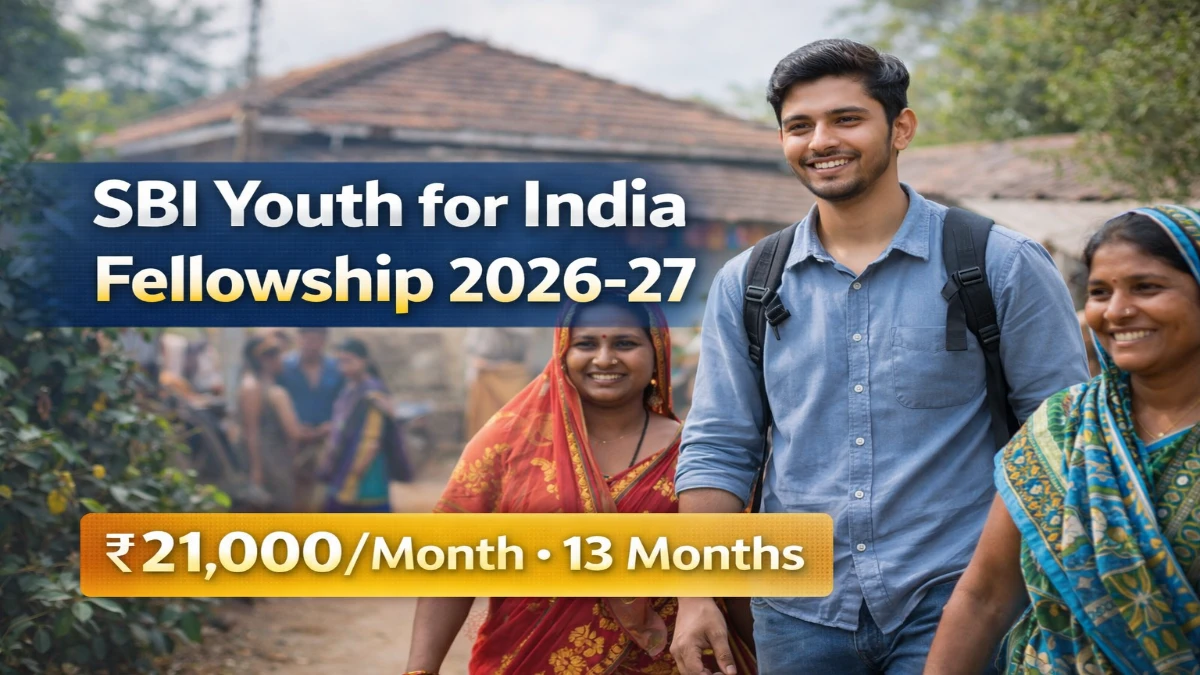
The SBI Youth for India Fellowship is a 13-month, fully supported rural development fellowship run by SBI Foundation in partnership with established NGOs across India. Applications for the 2026-27 batch are now live. If you are a graduate aged 21 to 32 with a genuine interest in working at the grassroots level, this fellowship puts you in a remote Indian village for over a year, working directly with rural communities on real development challenges, with a monthly allowance totalling Rs. 21,000 and a completion bonus of Rs. 1,10,000.
Since its launch in 2011, the programme has completed 14 batches and built a network of over 700 alumni who have worked at more than 250 rural locations across 22 states. This is not a token CSR programme or a weekend volunteering stint. It is a full-time, immersive commitment that requires you to relocate to a rural project site, live in conditions that may include erratic mobile connectivity, poor power supply, and unreliable internet, and spend 13 months designing and implementing community-level interventions alongside experienced NGO staff.
This guide covers everything you need to know before applying, from the exact financial breakdown and eligibility details to the two-stage selection process, the “no home state” policy, and practical realities of living in rural India that most fellowship guides conveniently skip.
What SBI Youth for India Actually Is (and Is Not)
This is worth clarifying upfront because the programme is frequently mislabelled online as an “SBI internship” or “SBI paid internship.” It is neither.
SBI Youth for India is a fellowship, not an internship or a job. It does not lead to employment at SBI. There is no guaranteed placement after the 13 months. You are not an SBI employee during the programme. The fellowship is funded and managed by SBI Foundation, which is SBI’s corporate social responsibility arm, and implemented through partner NGOs who have established presence in rural areas.
The programme seeks to achieve three things. First, it provides educated urban youth with an opportunity to work with rural communities and create positive change at the grassroots level. Second, it provides NGOs working on rural development projects with skilled human resources whose capabilities can catalyse their work. Third, it builds a long-term alumni community that continues contributing to rural development throughout their professional lives.
The 13-month duration is deliberate. The 13th month creates an overlap period with the incoming batch of fellows, allowing for smooth project handover and knowledge transfer. This structure acknowledges that rural development problems are complex and sustained effort is needed, and ensures project continuity beyond any single fellow’s tenure.
Financial Support: The Complete Picture
The total financial support over the 13-month fellowship amounts to approximately Rs. 3,83,000. Here is exactly how it breaks down.
Monthly Allowances (Rs. 21,000 per month)
You receive four separate monthly allowances, each designated for a specific purpose. Rs. 16,000 per month is for living expenses, covering food, daily necessities, and basic accommodation costs. Rs. 2,000 per month is for transport expenses related to your project and daily commute. Rs. 2,000 per month is for project-related expenses like materials, printing, or community engagement costs. Rs. 1,000 per month is for professional learning and development, allowing you to invest in books, courses, or other resources relevant to your growth.
Over 13 months, this totals Rs. 2,73,000 in monthly allowances.
Readjustment Allowance (Rs. 1,10,000)
Upon successful and satisfactory completion of the fellowship, you receive a one-time readjustment allowance of Rs. 1,10,000 along with a Certificate of Completion from SBI Foundation. This is specifically called a “readjustment allowance” because it is designed to help you transition back to urban life or your next career step after 13 months in a rural setting.
The word “satisfactory” matters here. This is not automatic. Your completion must be assessed as satisfactory by the programme, meaning you are expected to fulfil your commitments throughout the fellowship period.
Travel Support
The cost of return 3AC train fare from your residence to the project site location is covered. Travel expenses for attending training programmes during the fellowship are also covered. For candidates from Nepal, Bhutan, and OCI holders, air travel reimbursement is provided as per a pre-approved limit, since train travel from outside India is not feasible.
Insurance
A health and personal accident insurance policy is provided for the duration of the fellowship. This is an important practical benefit, given that you will be living in rural locations where medical infrastructure may be limited.
Language Support
A dedicated provision for language support is provided at the project location. This is especially relevant because of the “no home state” policy (explained below), which means you will almost certainly be placed in a state where you do not speak the local language. The partner NGO and its local staff facilitate communication, but having some language support helps you build direct rapport with the community.
Accommodation
The local NGO staff will assist you in finding suitable accommodation with safety in mind. Accommodation is not provided free of charge as a separate benefit. You are expected to cover it from your Rs. 16,000 monthly living allowance. In most rural locations, the cost of basic accommodation is significantly lower than in cities, so this is generally manageable.
Eligibility: Who Can Apply
The eligibility criteria are simple and clearly defined. Three conditions must be met.
Education
You must have completed a Bachelor’s degree on or before 4 October 2026. This means final-year students graduating in 2026 can apply even if their results are not declared at the time of application, as long as their degree will be completed by the cutoff date. The fellowship is open to graduates from any stream: engineering, commerce, arts, science, management, law, design, medicine, agriculture, or any other discipline. No specific degree or specialisation is required.
Age
You must be between 21 and 32 years of age on the date of commencement of the programme. For the 2026-27 batch, this means you must have been born between 4 August 1994 and 5 October 2005 (inclusive). There is no age relaxation mentioned for any category.
Nationality
You must be an Indian citizen, a citizen of Nepal or Bhutan, an Overseas Citizen of India (OCI), or a Non-Resident Indian (NRI). If you currently do not possess an OCI card, the programme advises you to visit the Ministry of Home Affairs website and initiate the OCI registration process early, as it can take 1 to 3 months.
SBI Employees
A provision exists for SBI employees as well. Confirmed Officers in Scale I or Scale II can apply as per internal circular CDO/P&HRD-CM/22/2025-26 dated 21 August 2025. This allows bank employees to take a career break for social service through the fellowship.
What They Are Really Looking For
Beyond the formal eligibility criteria, the programme website and FAQ make it clear that they value certain qualities. They are looking for a team player with a proactive approach and strong leadership skills, someone who is people-oriented and can interact with rural communities constantly, and someone genuinely willing to commit to 13 months of living and working in challenging rural conditions. No specific professional experience is required. Fellows from past batches have come from diverse backgrounds including information technology, education, infrastructure, non-profit, and healthcare. Major corporates like the Tata Group, Capgemini, Ernst and Young, and MindTree have given their employees sabbaticals to join the fellowship.
The “No Home State” Policy
This is one of the most distinctive aspects of SBI Youth for India, and one that most fellowship guides either gloss over or miss entirely.
The programme follows a strict “no home state” policy. This means you will not be placed in your home state. If you are from Bihar, you will not be posted in Bihar. If you are from Maharashtra, you will not work in Maharashtra.
The rationale is intentional: to encourage fellows to explore Indian diversity and work in a multicultural setting that is genuinely unfamiliar. The discomfort of navigating a new language, new customs, and a new community is considered a central part of the learning experience, not a bug but a feature.
This has significant practical implications. You will need to adapt to a completely different language, food, climate, and cultural context. The partner NGO’s local staff help bridge the language and cultural barriers, but the adjustment is real and should not be underestimated.
Where You Could Be Posted
Projects are located across 17 states: Andhra Pradesh, Assam, Bihar, Gujarat, Karnataka, Kerala, Madhya Pradesh, Maharashtra, Odisha, Rajasthan, Tamil Nadu, Punjab, Meghalaya, Himachal Pradesh, Uttarakhand, Telangana, and Jharkhand.
At least two fellows are posted at each project location, so you will not be completely alone. You will have a co-fellow to share the experience with, and the partner NGO’s local team provides ongoing support and guidance.
The specific location is decided based on a combination of your interests, skill sets, and the needs of the partner NGOs for their various projects. After selection, you will have access to material about the programmes of partner NGOs and can research and discuss options before the final placement is decided.
Application Process: Two Stages
The application for the 2026-27 batch is currently live and follows a two-stage process. Apply at https://change.youthforindia.org/application-process/apply/4798.
Stage 1: Registration and Online Assessment
Stage 1 is entirely online and has two parts. First, you complete the registration form and respond to a few preliminary questions for initial review. If your application aligns with the fellowship’s values and selection criteria, you are shortlisted and invited to the second part: submitting essays, a short reflective video, and additional supporting information.
The essay component asks you to share your story, perspectives, intention to join the fellowship, and overall worldview through detailed, essay-based responses. This is not a test of writing skill alone. The selection team is evaluating whether you have genuine motivation and a thoughtful understanding of what grassroots work involves.
You are also required to provide details of two recommenders: one academic recommender (a professor, Head of Department, or similar) and one professional recommender (a former boss, supervisor, colleague, mentor, advisor, or ex-SBI YFI Fellow). For freshers, a recommendation from an organisation where you have interned or volunteered is accepted as the professional recommendation. Recommendations from family members or friends are not accepted. Once you submit your online assessment, a recommendation request is automatically triggered via email to your recommenders, so make sure they are available and responsive.
Stage 2: Group Exercise and Personal Interaction (In-Person)
Candidates shortlisted from Stage 1 are invited to Stage 2, which is conducted in-person. This round includes a group exercise designed to evaluate collaboration, thinking style, and engagement, followed by a personal interaction session that assesses motivation, lived experiences, and alignment with the fellowship’s work.
For the 2026-27 batch, Stage 2 interviews will primarily be conducted in-person. Virtual interviews may be offered only in special circumstances. However, citizens of Nepal, Bhutan, and OCI candidates can appear for interviews virtually, though the orientation programme after selection will require every selected fellow to attend in person.
Rolling Notifications
An important detail that affects your timing: shortlisted candidates are notified on a rolling basis during the application period. This means the earlier you apply, the earlier you may be notified and the more you can engage with the programme team through the online forum before the fellowship begins. The official FAQ explicitly recommends applying early for this reason.
The exact last date for applications for the 2026-27 batch will be announced on the official website and social media channels.
Programme Structure: What 13 Months Look Like
The fellowship begins with a carefully designed orientation and training programme that includes both classroom sessions and field visits. This induction phase equips you with the frameworks, tools, and contextual understanding needed to work effectively in a rural setting.
After orientation, you are sent to your rural project location to work on a specific project. Throughout the duration, a mentor from the partner NGO ensures you have the support needed to address challenges. There are two periodic review workshops during the fellowship for guidance and course correction. A dedicated SBI YFI team member is also available throughout to provide support.
The projects span a wide range of domains. Past fellows have worked on education, healthcare, environmental sustainability, rural livelihoods, women’s empowerment, water management, agriculture, and more. The programme is not restricted to any specific area and offers flexibility to design a feasible project of your own within the focus areas of the partner NGO’s work. However, projects must be structured as interventions attempting to bring about measurable change, not just research or observation.
Daily Life as a Fellow: The Honest Version
The official FAQ is refreshingly candid about the challenges of living in rural India, and it is worth taking those seriously before applying.
You should expect erratic mobile connectivity, poor power supply, and unreliable internet. The programme frames this positively, saying it might help you reduce dependency on the props of modern living, but practically it means you may not be able to stay constantly connected with family and friends or stream content in the evenings.
You might not have ready access to shops and markets, although basic provisions will be available. Daily tasks differ from fellow to fellow and project to project. Depending on your project, you may spend long hours attending community meetings, interacting with villagers, participating in community activities, and dealing with an unpredictable work schedule.
The partner NGOs are reputed organisations with over two decades of grassroots experience, and the project locations are chosen with safety in mind. Local networks exist for medical and other emergencies. But you are advised to be aware, stay alert, align with local customs, and closely follow the advice of your local NGO facilitator.
This is why the fellowship is not for everyone, and the selection process tries to identify people who genuinely understand and welcome these conditions rather than those who are simply looking for a resume line.
After the Fellowship: What Comes Next
The fellowship does not guarantee a job or placement after completion. However, it opens several career paths that did not exist before.
Many alumni have moved into leadership roles with NGOs or organisations in public policy, implementation, research, and advocacy. Others have become social entrepreneurs. Some have returned to the corporate world and leveraged their rural insights to influence perceptions and develop products and services suited to rural markets. Post-fellowship, SBI YFI continues to support alumni through mentorship, guidance, networking support, and referrals.
If you wish to continue working at your project location after the fellowship period, SBI cannot extend the fellowship. However, interested fellows can work out an arrangement directly with the partner NGO to continue on mutually agreed terms. A number of alumni have taken this route.
The fellowship also provides a certificate of completion from SBI Foundation, which carries recognition in both the social sector and the corporate world.
Frequently Asked Questions
Do I need specific experience or a particular degree to apply?
No. The fellowship is open to graduates from any stream and any discipline. No specific professional experience is required beyond meeting the basic eligibility criteria. Past fellows have included engineers, commerce graduates, lawyers, medical professionals, and arts graduates. The selection evaluates your motivation and fit, not your technical qualifications.
Can final-year students apply?
Yes. If you are in your final year and your degree will be completed on or before 4 October 2026, you are eligible to apply.
Is this a full-time commitment? Can I do it part-time?
Yes, it is strictly full-time. Part-time participation is not accommodated. You are expected to reside at the project location for the entire 13-month duration.
Will I be posted in my home state?
No. The programme follows a strict “no home state” policy. You will be placed in a state different from your home state.
Can I choose which NGO or project I work with?
Not directly during the application. After selection, you will have access to information about partner NGO programmes. Placement is decided based on a combination of your interests, skills, and the needs of the partner NGOs.
What if I do not speak the local language at my project site?
The programme provides dedicated language support at the location. The partner NGO’s local staff also help bridge language and cultural barriers. Many past fellows have navigated this successfully with support.
How many fellows are selected per batch?
Approximately 120 to 150 fellows are selected per batch, based on available data. At least two fellows are posted at each project location.
Is there an application fee?
No. The application process is free.
Can NRIs apply?
Yes. Indian citizens, citizens of Nepal and Bhutan, OCI holders, and NRIs are all eligible.
What is the last date to apply for 2026-27?
The exact last date has not been announced yet. The programme advises applying early, as shortlisted candidates are notified on a rolling basis. Applications are submitted online only at the official portal.
Can I extend the fellowship beyond 13 months?
No. SBI cannot extend the fellowship. However, you can independently arrange to continue working with the partner NGO on mutually agreed terms.
Is the Rs. 1,10,000 completion bonus automatic?
No. It is paid upon “successful and satisfactory” completion. If you leave early or your performance is deemed unsatisfactory, you may not receive it.
Official Links and Contact
The official website is youthforindia.org. The direct application link for the 2026-27 batch is https://change.youthforindia.org/application-process/apply/4798. For any queries, email [email protected]. The programme is run by SBI Foundation, Corporate Centre, Madam Cama Road, Nariman Point, Mumbai 400021.
Eligibility Criteria
- Age: 21-32 years
- Education: Bachelor’s degree (or must complete by October 4, 2026)
- Nationality: Indian citizens, OCI, citizens of Nepal/Bhutan
- Mindset: Willing to live in rural areas for 13 months
Benefits & Stipend
- Monthly Stipend: ₹20,000 (₹16,000 living + ₹2,000 transport + ₹2,000 project)
- Professional Learning: ₹1,000/month
- Completion Bonus: ₹1,10,000
- Travel: 3AC train tickets covered
- Insurance: Medical and personal accident insurance
Application Process
- Visit the official website: youthforindia.org
- Register with your email
- Complete the online assessment
- Upload a reflective video
- Attend the personal interview if shortlisted
- Submit required documents
Documents Required
- Graduation Marksheet
- ID Proofs
- Two recommenders' contact information
Selection Process
The selection process includes an online assessment focusing on essays and a personal interview. Candidates are evaluated on their motivation and readiness for rural life.
📅 Important Dates
| Application Start | February 2026 |
| Last Date | April 30, 2026 |
| Fellowship Starts | August/September 2026 |
Frequently Asked Questions
Fellowship Details
| Full Name | SBI Youth for India Fellowship 2026: Apply Online, Last Date & Stipend Details |
| Stipend/Award | ₹20,000/month |
| Duration | 13 months |
| Type | Social Sector |
| Status | Closed |
| Last Date | 30 Apr 2026 Expired |
| Qualification | Bachelor's degree |
| Research Area | Rural Development |
| Gender | All |
| Age Range | 21 — 32 years |
| Department | Government of India |
| Provider | State Bank of India (SBI) |
| Category | Rural Development |
| Source | thefellowships.in |
| Provider | State Bank of India (SBI) (Central Government) |
| Official Website | www.youthforindia.org ↗ |
| Apply Link | www.youthforindia.org ↗ |
| [email protected] | |
| Phone | +91-22-2282-0000 |
| Next Cycle | 2027 |
 Deepika Raikwar
 ALOK KUMAR
Deepika Raikwar is an Education Analyst and scholarship researcher who focuses on public welfare and merit-based scholarships. She simplifies complex eligibility rules, deadlines, and application processes to help common people access reliable funding opportunities worldwide.
View all posts by Deepika Raikwar →
Fresher
I am a Teacher experience 5 years
Very Nice
Only fresher
Only fresher
Retail line 2 years experience as a cashier
Freshar
3 years teaching experience
I’m fresher but completed internship in HR operations
All work